How to pass the MAST test in Washington comes down to understanding six topic areas, knowing what the exam actually looks like, and walking in with enough familiarity that unfamiliar wording doesn’t throw you off. Ninety-nine percent of ServeSmart students pass on their first attempt, and the ones who don’t usually fail for the same reason: they treated the exam as a formality and didn’t study the material on liability and apparently intoxicated person (AIP) identification.
This guide is built for people already enrolled (or about to enroll) who want to pass on the first try. It covers exactly what the 40-question exam tests, the topics WSLCB-approved courses are required to cover, seven practice questions written to match the real exam’s format and difficulty, and the mistakes that cause most first-time failures.
Not enrolled yet?
WSLCB-approved · 99% first-attempt pass rate · Valid 5 years statewide
Table of Contents
Exam Format: What to Expect on Test Day
Before you start studying, know what you’re studying for. The MAST exam has the same basic shape across every WSLCB-approved provider:
- 40 questions total
- Multiple choice and true/false – no essays, no short answers
- 80% to pass (32 out of 40 questions correct)
- Two attempts are included with your enrollment at ServeSmart – most providers allow unlimited free retakes
- No time limit on most online versions – you can take as long as you need
- Open-book is not allowed – the exam is meant to test what you’ve learned, not your ability to look things up
- Once you start the final exam, you can’t go back and review module content – make sure you feel ready before clicking start
The questions are drawn from the six WSLCB-required curriculum areas. Not every topic gets equal weight – in practice, ID checking, AIP identification, and liability carry more questions than the “overview of WSLCB rules” module, because those are the areas where real-world mistakes happen.
The Six Topic Areas You'll Be Tested On
Every WSLCB-approved MAST course covers the same six modules. The exam draws from all six, so you need to be solid on each. Here’s what to focus on in each area.
1. Mandatory Alcohol Server Training Rules
This is the most straightforward module. Expect questions like: how long is the permit valid (5 years), how many days after hire do you have to get certified (60 days – with no grace period for tastings or events), who issues the permit (the course provider, not WSLCB), how long does it take to receive your permit in the mail (up to 30 days), and who enforces MAST rules (the WSLCB’s Enforcement and Education Division).
You should also know the permit class basics cold: Class 12 for 21+, Class 13 for 18–20. The full breakdown lives on our Class 12 vs Class 13 MAST permit guide.
2. Alcohol and Its Effects on the Body
This is where BAC math and the physiology of intoxication show up. Know the Washington drink equivalents: one standard drink equals 12 oz of beer at 5% ABV, 5 oz of wine at 12% ABV, or 1.5 oz of 80-proof spirits. Know what factors affect BAC: body weight, biological sex, food in the stomach, rate of consumption, and type of drink.
The exam will test whether you can recognize that a 120-pound person drinking three shots in an hour is a much higher-BAC situation than a 200-pound person drinking three beers across three hours, even though the total “drinks” looks similar on paper.
You’ll also see questions about the physiological stages of impairment, euphoria, excitement, confusion, stupor, and the visible signs that go with each.
3. Checking IDs and Spotting Minors
This module carries significant weight on the exam. Know the acceptable forms of ID in Washington: driver’s license, state ID card, instruction permit (from any US state, Canadian province, US territory, or DC), Washington temporary driver’s license paired with an expired ID, US military ID, Merchant Marine ID, Washington Tribal Enrollment Card, or a passport/passport card/NEXUS card.
You need to be able to describe the physical signs of a fake or altered ID: glue lines near the photo, different fonts on the date of birth, ragged edges, dull or blurry images, holographic security features that don’t change when the card is tilted.
Know the verification steps: compare the height listed on the ID to the person in front of you, check the hairline, eyebrows, and chin shape against the photo, and when in doubt, ask for a second form of ID or call a manager.
4. Apparently Intoxicated Person (AIP)
This is the area where most servers have the weakest instincts and where the exam will catch you. An AIP isn’t just “someone drunk”, it’s someone showing observable signs of intoxication, which is a legal standard, not a judgment call. Signs include slurred speech, bloodshot or glassy eyes, uncoordinated movement, aggressive or overly friendly behavior, loud or repetitive speech, and difficulty counting money.
Critically, you may not serve an AIP under any circumstances, and they can’t buy a drink for someone else either. The friend of an AIP ordering “a round” is a common exam trap.
When you identify an AIP, Washington law requires you to refuse service. Serving one glass of water and then another drink is not an acceptable substitute. Documenting the refusal in an incident log is a best practice and often tested.
5. Liability and Dram Shop Law
Washington is a dram shop state, meaning that a server, bartender, or establishment can be held civilly liable if an intoxicated patron causes harm (typically a DUI crash) after being over-served. Personal liability applies to you as the server, not just the business.
Key facts to know: an affidavit from a customer saying “I won’t hold you liable” does not protect you or your employer, and you can’t waive liability through a handshake agreement. Third-party liability means that if a drunk driver you served hurts someone else, both you and the establishment can be sued by the victim.
Also, know the DUI penalties a customer can face in Washington: fines up to $5,000, higher insurance premiums, and criminal charges, because understanding the stakes for the customer helps justify refusing service to an AIP.
6. Washington Alcohol Laws and MAST Rules
This covers the rules that govern day-to-day operation: happy hour regulations, what can and can’t be advertised, rules around hours of service, the prohibition on “drinking games” at licensed establishments, the requirement to carry your permit and ID at all times while working, and the penalties for common violations.
For first violations of serving an AIP or a minor, the monetary option is typically $500 for the individual server, with higher amounts for the licensee. Penalties escalate fast on subsequent violations within a two-year window.
7 Practice Questions (With Explanations)
These questions are written to match the real exam’s format and topic mix. They’re not leaked answers; they’re representative of what you’ll see. Don’t skip the explanations: understanding why an answer is right is what helps you get unfamiliar questions correct on test day.

Question 1
A customer who appears to be intoxicated asks you to sell him a bottle of wine to take home. What should you do?
- A. Sell the wine since he's taking it home, not drinking it here
- B. Refuse the sale, an AIP cannot legally be sold alcohol, on- or off-premises
- C. Sell the wine but ask him to drink a glass of water first
- D. Ask his friend to buy it for him instead
Correct answer: B. An Apparently Intoxicated Person cannot be sold alcohol in any form, bottled, on-premises, or through a third party. Option D is a common trap: selling to someone the AIP will consume with is still a violation.
Question 2
Which of the following is an acceptable form of identification in Washington?
- A. A school ID with a photograph
- B. A social security card
- C. A passport from any country
- D. A US military ID
Correct answer: D. US military IDs are on the WSLCB’s accepted list. School IDs and social security cards are never acceptable. Passports from other countries can be accepted, but this question’s wording (“from any country”) is too broad — the safe answer is D.
Question 3
How many days does a newly-hired alcohol server have to obtain their MAST permit?
- A. 30 days
- B. 60 days
- C. 90 days
- D. They must have it on day one
Correct answer: B. Washington gives newly-hired alcohol servers 60 days from their start date to complete MAST training and pass the exam. Note that this grace period does not apply to alcohol tasting events; those require a permit from day one, with no grace period.
Question 4
A regular customer has had four drinks over three hours and is showing no visible signs of intoxication. He orders a fifth. What should you do?
- A. Refuse service, four drinks is always over the limit
- B. Serve the drink and continue observing him for signs of impairment
- C. Ask him to wait 30 minutes before ordering another
- D. Call a cab for him before serving
Correct answer: B. Intoxication is determined by observable signs, not drink count. Body weight, food consumption, rate of drinking, and tolerance all affect BAC. Your job is to continuously observe — if he starts showing signs of impairment, refuse further service at that point.
Question 5
Which of the following is a visible sign that an ID may be fake or altered?
- A. The ID is from a different state
- B. The ID is slightly bent
- C. The person looks slightly different from the photo
- D. The font on the date of birth doesn't match other text on the ID
Correct answer: D. Inconsistent fonts are a classic sign of tampering. Out-of-state IDs are valid (A), minor appearance changes are normal as people age (C), and bent IDs happen from normal wear (B). Fonts that don’t match across different fields are a red flag for alteration.
Question 6
Under Washington’s dram shop law, which of the following is true?
- A. Only the establishment can be sued if an over-served customer causes harm
- B. Both the server and the establishment can be held liable for serving an AIP
- C. A signed waiver from the customer protects the server from liability
- D. Liability only applies if the customer was already drunk when they arrived
Correct answer: B. Washington holds both individual servers and the business liable for over-service. A and D are too narrow; C is a common misconception, no waiver or affidavit from a customer can override dram shop liability.
Question 7
You notice a group of four at a table, and one person is clearly showing signs of intoxication. Another person at the table orders a round of drinks. What’s your correct response?
- A. Serve the round, the order didn't come from the intoxicated person
- B. Serve only the three non-intoxicated people
- C. Refuse the entire round, you cannot serve alcohol that will be consumed by an AIP
- D. Ask the intoxicated person to leave first, then serve the others
Correct answer: C. This is one of the hardest real-world calls. Washington law prohibits serving an AIP through a third party; the drink doesn’t have to be ordered by the AIP for it to count as serving them. Refusing the whole round is awkward but legally required. In practice, you’d pull the sober orderer aside, explain the situation calmly, and offer water, coffee, and food for the table.
The Top 5 Reasons People Fail the MAST Exam (and How to Avoid Them)
They rushed through the course. The course saves your progress; there’s no reason to cram it into one sitting. Students who break it into three 1-hour sessions across two or three days retain the material far better than students who blast through in a single afternoon.
They skipped the module quizzes. Every WSLCB-approved course has end-of-module quizzes. These are structured to test the same topics as the final exam. Students who take the quizzes seriously and review the questions they got wrong pass the final at a dramatically higher rate than students who click through for the completion check.
They overthink AIP questions. The most common wrong answers on AIP questions come from servers who want to be “fair” to the customer, trying to negotiate, compromise, or find a workaround. The exam is testing whether you understand that the legal standard is clear-cut: observable signs = refusal, no exceptions.
They miss the third-party trap. The single most commonly missed question category is third-party service, serving an AIP indirectly through a friend, family member, or drink runner. If you take one thing away from this guide, you cannot serve a drink that will be consumed by an AIP, regardless of who ordered it.
They forget the permit basics. It sounds silly, but a few questions on every exam come from the “MAST rules” module: how long is the permit valid, who issues it, and how many days do you have to get certified. Missing these is pure points left on the table.
How to Pass the MAST Test: What to Do the Night Before
Most students don’t need to pull an all-nighter to pass, 99% pass on the first try at ServeSmart with normal preparation. But if you want to walk in feeling confident:
- Re-read the two hardest modules for most people: AIP (module 4) and Liability (module 5).
- Revisit any module quiz question you got wrong the first time.
- Review the seven practice questions above.
- Get a good night’s sleep. Seriously, the exam is not complicated; it rewards a clear head.
You can also open the course back up and review any module as many times as you want before clicking the final exam. Once you start the exam, that review access is gone.
After You Pass
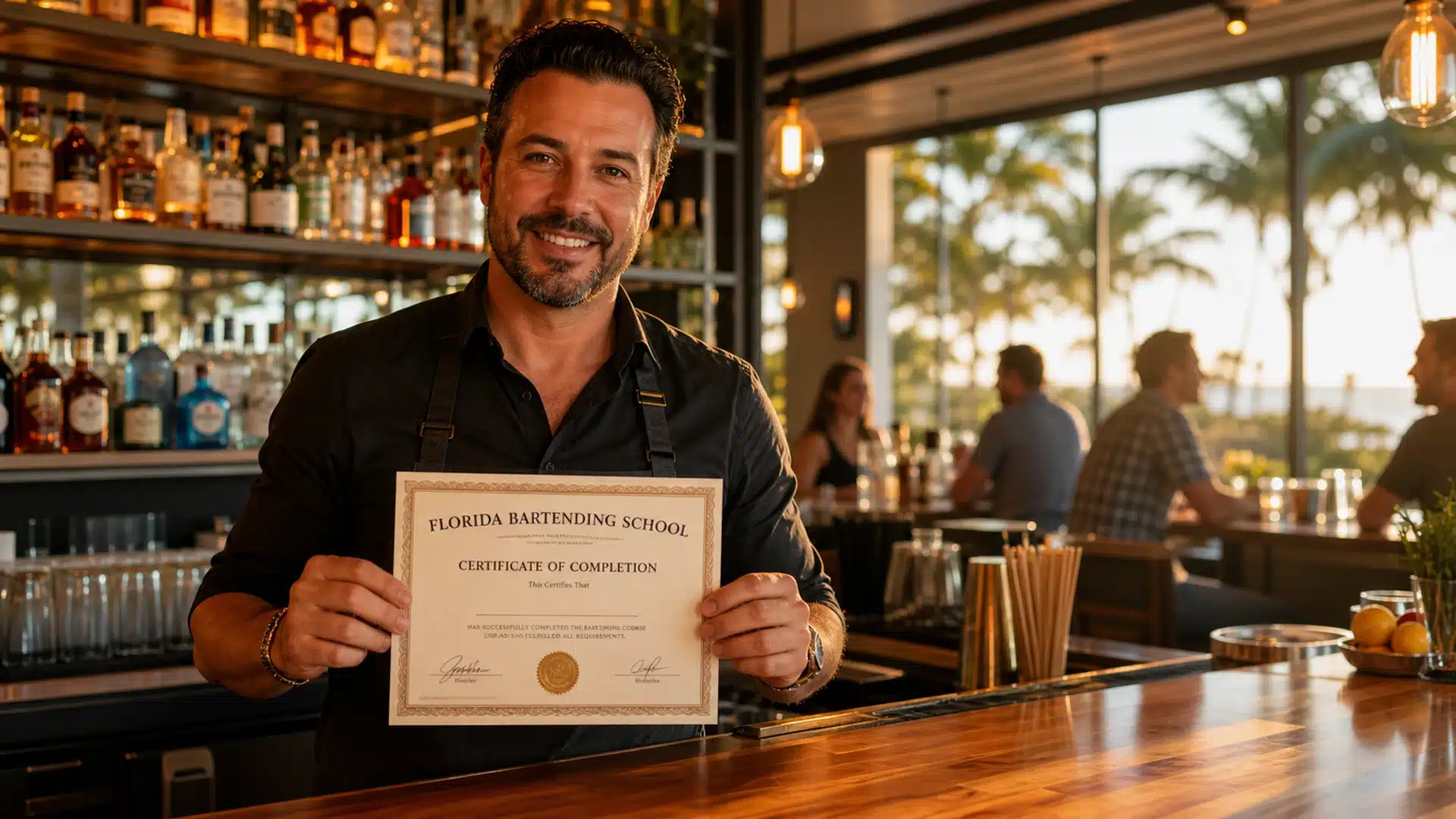
Your Certificate of Completion is available immediately after you pass the 80%+ threshold. You can show this to your employer the same day. Your official MAST permit card is then processed and mailed by your course provider within 30 days.
For what happens next, using your permit, keeping it current, and what to do when it’s time to retake, see our MAST permit renewal guide.
Ready to Get Certified?
If you haven’t enrolled yet, ServeSmart’s WSLCB-approved course takes about 3 hours, costs $19.99, and includes two free exam attempts. The full enrollment process is covered in our how to get a MAST permit guide.
WSLCB-approved · 99% first-attempt pass rate · Start in the next 5 minutes
Frequently Asked Questions
The exam is 40 multiple-choice and true/false questions. Most students finish in 20–40 minutes, though most online versions have no time limit.
80% or higher, 32 out of 40 questions correct.
ServeSmart includes two attempts with enrollment, and if you fail both, retakes are free. You’ll want to review the course material before your next attempt, focusing on the modules tied to the questions you missed.
No legitimate site publishes actual leaked MAST exam answers, and for good reason, the exam exists to test whether you’ll recognize an over-served customer before they leave and cause harm. Study-guide content like the practice questions above is the right preparation.
The exam is meant to be closed-book. Before you click the final exam button, you can review any module as many times as you want. Once you start, you can’t go back.
ServeSmart charges $19.99 for the full course including the exam and two attempts. See our how to get a MAST permit guide for a comparison of other WSLCB-approved providers.
No, the same course and the same exam qualify you for both. The permit you receive depends on your age at the time of certification. Full breakdown in our Class 12 vs Class 13 guide.